
Advocacy
NAAPR Advocacy Toolkit 2026: The Power of Your Voice
A Guide for Refugees and Immigrants to Shape and Influence Policy

Despite the contributions of refugees and immigrants to the economic, intellectual, and cultural success of the United States, they are currently described and seen as a threat to American national security and a burden on societal resources. The media mostly shows images of immigrants and refugees that make them seem like they are coming to the United States with no valuable skills or agency, and that they are going to use all our resources or steal jobs. Politicians also exploit these ideas and describe immigrants and refugees as coming to the U.S. with bad intentions to harm this country. But refugees and immigrants, with their resilience and strength, can change this false narrative by getting involved in the policy process to make change happen – for yourselves, your communities, and society.

We often hear that refugees and immigrants are unfamiliar with or unwilling to engage in policy advocacy. We believe there have not been enough resources to hear from them to ensure policy decisions are relevant to their needs. Many of our community members, especially refugees, tell us about their daily struggles because there are no targeted policies that address their needs. Your voices are crucial in this process.
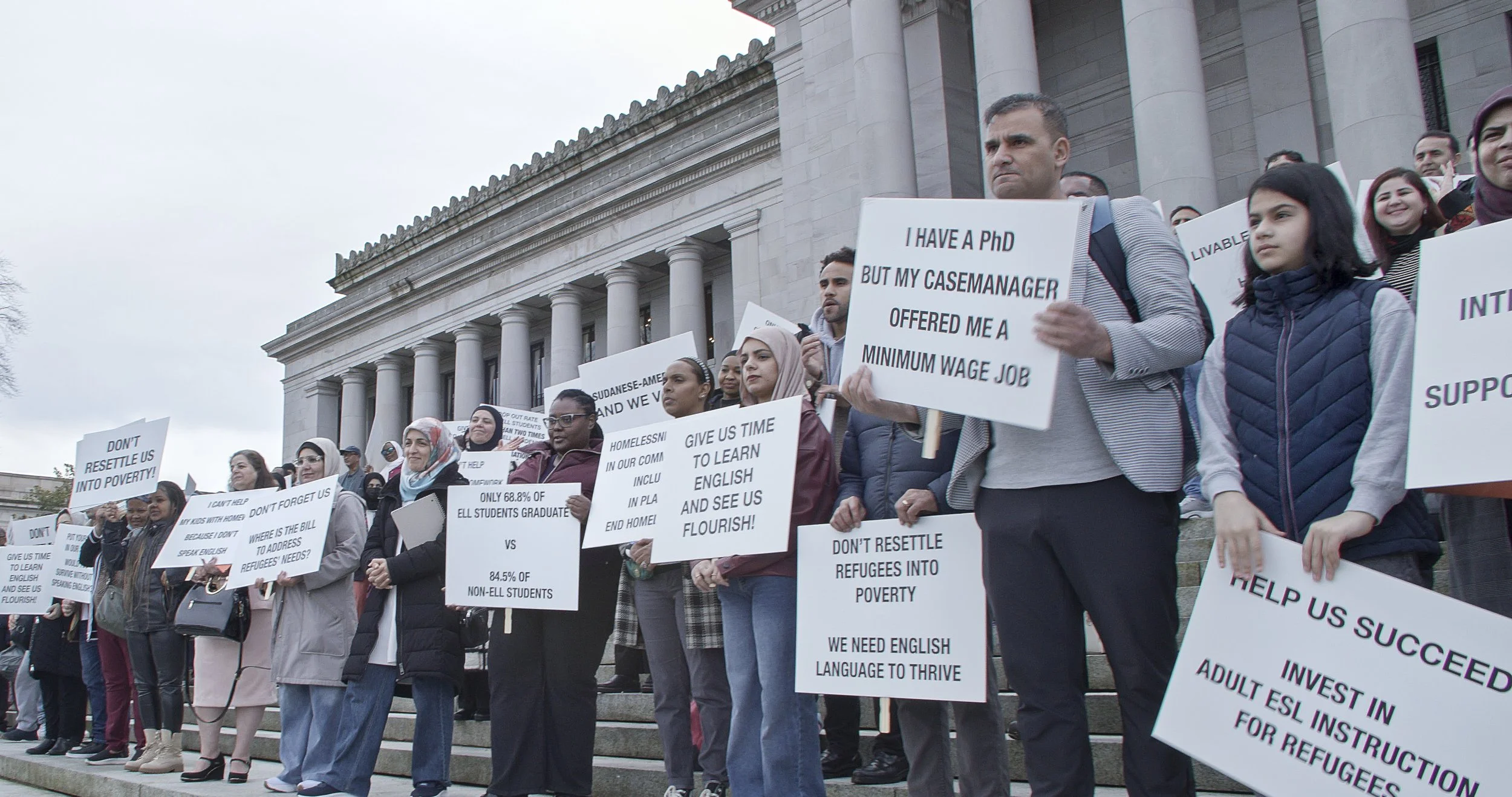
Let's consider the Refugee Act of 1980, which is supposed to lead to successful integration of refugees and set the policy for what kind of assistance refugees receive. The main goal of the U.S. refugee resettlement program has been to move refugees into paid employment within 3-6 months after arrival to ensure "self-sufficiency." To meet this expectation, refugee resettlement agencies' primary goal is to place refugees in employment as quickly as possible. As a result, refugees are placed into survival jobs which have low pay, high turnover, and part-time hours, no matter what professional skills they already have.
This rapid employment model also deprioritizes English language learning, even though English skills are connected to future economic success. Without English, it is hard for refugees to move to better jobs in the future. Many experts agree that the current policy needs to be changed, as it does not prepare refugees for long-term economic success and full integration.
How do we change this and other policies? The power to do so lies with you. Your active participation in policy development is crucial for creating policies that are more effective, relevant, and impactful. Change may take time and effort, but it is within your reach. Remember, inaction only serves to keep things the way they are, causing you, your children, and future generations to continue facing the same problems. Your voice matters, and your advocacy can make a difference.
Someireh Amirfaiz, Ed. D.
NAAPR Founder and Executive Director
Our goal with this toolkit is to empower you. We hope it will help you discover your passion and provide you with practical tips for advocating for policies that are informed by your experiences and the experiences of other community members. This toolkit is a resource for you to use, to find your voice, and to make a difference.
This is your opportunity to become a fierce and fearless advocate, to engage, and to take action. That’s the only way for us to create transformative and long-lasting change.
Policy
The United States’ foreign and domestic policy has profound implications on millions of individuals. In particular, the immigration and refugee policies greatly impact the prosperity, inclusion, power, and influence of New Americans. By building a community of well-informed policy advocates, we hope to ensure decision makers are informed about the issues facing New Americans and how to craft solutions. We achieve our purpose through four strategies:
Amplifying New American voices in policy-making through discussions about the benefits, harms, and deficiencies of policies related to them.
Encouraging New Americans to learn and actively participate in the policy process.
Highlighting policy decisions that result in forced migration, displacement, and the refugee crisis.
Utilizing
existing New American leaders to promote policy recommendations and support their efforts via policy advocacy.
Are you a policy analyst, or legal or political science expert? Help us succinctly showcase the policy decision that hurt New Americans, and by extension, hurt us all.
Are you a community leader? Learn how you can support New American voices.
What is Public Policy
Whatever government chooses to do or not to do
Decisions by government to alter or change the status quo
The actions of government and the intentions that determine those actions
These definitions share the ideas that:
Policy responds to a problem
The policy is made on the “public’s behalf”
Policies have goals
Policies are made by governments
Policies are implemented by public and private actors
Policy can be action or inaction
Social Construction of Target Population
Refers to:
The recognition of the shared characteristics that distinguish a target population as socially meaningful, and the attribution of specific, valence-oriented values, symbols, and images to the characteristics.
Social constructions are stereotypes about particular groups of people that have been created by politics, culture, socialization, history, the media, literature, religion, and the like.
Social Constructions are the Normative and Evaluative Images Individuals Hold Concerning Definable Groups
“Social constructions emerge from emotional and intuitive reactions…”
More than simple stereotypes, social constructions are mutually reinforcing, making the resistant (but not immune) to change.
Both positive and negative constructions influence political debates and policy design.
The agenda, tools, and rationales of policy impart messages to target populations that inform them of their status as citizens and how they and people like themselves are likely to be treated by government. Such information becomes internalized into a conception of the meaning of citizenship that influences their orientations toward government and their participation.
Policy teaches lessons about the type of groups people belong to, what they deserve from government, and what is expected of them. The messages indicate whether the problems of the target population are legitimate ones for government attention, what kind of game politics is (public-spirited or the pursuit of private interests), and who usually wins.
Social Constructions Reveal the Ways in Which Policy Creatice Politics
Policy designs have both material and symbolic effects on target populations.
Material effects of policy design on target populations could involve the structuring of opportunities.
Symbolic effects of policy design are seen in political participation.
Social constructions become embedded in policy as messages that are absorbed by citizens and affect their orientations and participation patterns.
Policy sends messages about what government is supposed to do, which citizens are deserving (and which are not), and what kinds of attitudes and participatory patterns are appropriate in a democratic society.
There are strong pressures for public officials to provide beneficial policy to powerful, positively constructed target populations and to devise punitive, punishment oriented policy for negatively constructed groups.